
Doug Tallamy1 says to think of each plant in your yard as a bird feeder. From a bird’s perspective, “It either has food in it, or it doesn’t”. Tallamy, an entomology professor at the University of Delaware, is the well-known author of Nature’s Best Hope, A New Approach to Conservation That Starts in Your Yard. He explains why native plants are needed in our yards to slow and reverse the declining populations of both pollinators and breeding birds.
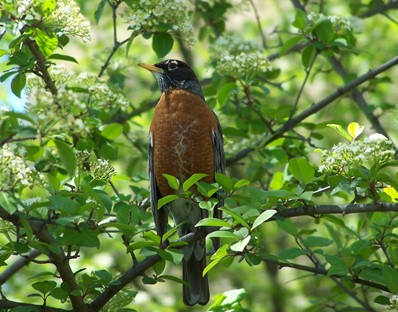
Berries and seeds produced by plants are important for the survival of migrating or over-wintering birds in our area. Yet to support breeding birds, we need to provide native plants that support healthy insect populations. Birds eat insects, and baby birds are fed exclusively soft insects, particularly the caterpillars of butterflies and moths (Lepidoptera). To a baby bird, a caterpillar is a tasty, gooey tube of protein and fat.
Most terrestrial breeding birds need a constant source of caterpillars to raise their young. For example, an observed breeding pair of Chickadees collected 1 caterpillar every 3 minutes, from 6 am to 8 pm for 16 days. That’s 6200 to 9000 caterpillars to raise one clutch of baby Chickadees.
Where do bird parents find this super-food? The studied Chickadee pair foraged for caterpillars living on plants within 150 feet of their nest. That means we need species of plants in our yard that feed caterpillars. These are called ‘host’ plants.
A study2 co-authored by Tallamy compared yards landscaped with traditional, non-native plants (think Boxwoods and Callery Pear trees) to yards landscaped with native plants. The study found that “bird species of regional conservation concern were 8 times more abundant” on native properties, due to more available lepidoptera. Insects evolved the ability to digest our native plants. A non-native plant that supports few if any caterpillars is the same as having an empty bird feeder in your yard.
When planning your landscape additions to provide for birds, select native plants that are host plants. Here are a few of the native plants we provide and the corresponding number of native Lepidoptera species hosted. Many of these plants also provide seeds, berries, nectar, and nesting locations and materials.
Trees:
Oaks (Quercus species) – 518
Pussy Willow (Salix species) – 440
Black Cherry, Choke Cherry and American Plum (Prunus species) – 429
River Birch (Betula nigra) – 400
Maples (Acer species) – 287
Blackberry/Raspberry (Rubus species) – 151
Basswood (Tilia americana) – 142
Walnut/Butternut (Juglans species) – 123
Serviceberry (Amelanchier species) -119
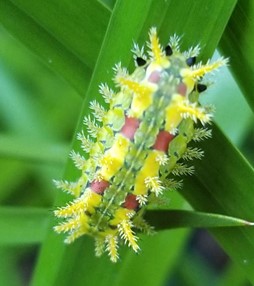
Spiny oak slug (Euclea delphinii) caterpillar
Shrubs:
Dogwood (Cornus species)-115
Bayberry (Myrica pensylvanica) -106
Viburnum – 97
Sumac (Rhus species) – 54
Elderberry (Sambucus canadensis) – 40
Perennials:
Goldenrod (Solidago species) – 112
Asters – 105
Joe Pye/Boneset (Eupatorium species) – 40
Violet (Viola species) – 27
Hardy Geranium (Geranium maculatum) – 23
Nodding Onion (Allium cernuum) – 20
Brown-eyed Susan, Black-eyed Susan (Rudbeckia species) – 16
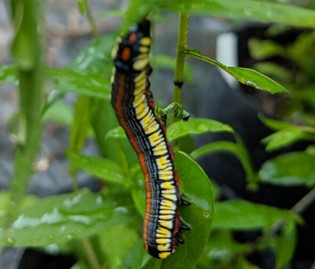
Brown-hooded owlet caterpillar (Cucullia convexipennis) on Goldenrod
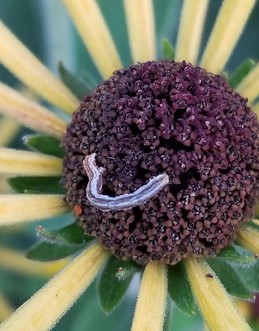
Caterpillar on Rudbeckia subtomentosa ‘Henry Eilers’
Grass:
Sedges (Carex species) – 36
Switchgrass (Panicum virgatum) – 24
Big Bluestem (Andropogon gerardii) -11
Little Bluestem (Schizachyrium scoparium) – 6
Ferns:
Christmas Fern (Polystichum acrostichoides)-6
Royal Fern (Osmunda regalis var. spectabilis)-6
Cinnamon Fern (Osmunda cinnamomea)- 4
Sensitive Fern (Onoclea sensibilis) – 2
Vines:
Honeysuckle (Lonicera sempervirens) – 33
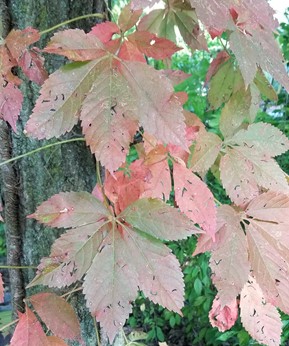
Virginia creeper (Parthenocissus quinquefolia)-32
Trumpet creeper (Campsis radicans) – 7
Virginia creeper (Parthenocissus quinquefolia)
- Doug Tallamy Presentation https://youtu.be/WY4aV5hqkxY
2. Impact of Native Plants on Bird and Butterfly Biodiversity in Suburban Landscape https://conbio.onlinelibrary.wiley.com/doi/full/10.1111/j.1523-1739.2008.01076.x
Photos of butterflies and their host plants
https://www.bgohio.org/wp-content/uploads/2014/05/Butterfly-Tree-Hosts-12-27-12.pdf
