
Fall is a great time for planting trees and shrubs. The desiccating heat of summer has passed. Winter’s frozen ground is still months off. Deciduous woody plants do much or even most of their root growth during the time when the above-ground parts are dormant. This means that if you can get your trees and shrubs planted and settled in before winter comes, they can take full advantage of prime time for root development. This in turn will mean better performance when the spring rains come to bring life back to the surface.
Conventional practice for the spacing of plants uses estimates of a plant’s maximum mature size to determine an appropriate distance of separation. I would challenge you to rethink this habit and consider the spacing found in many forests and natural areas. A Burr Oak (Quercus macrocarpa) can expect to see a mature height of up to around 100 feet, with an equivalent crown diameter. This would lead many to locate Burr Oaks on at least 100-foot centers, meaning not planted within 100 feet of another Burr Oak. This imagines a day, more than a century after planting, that the two crowns might nearly meet and ensures they do not overlap and somehow compete negatively.
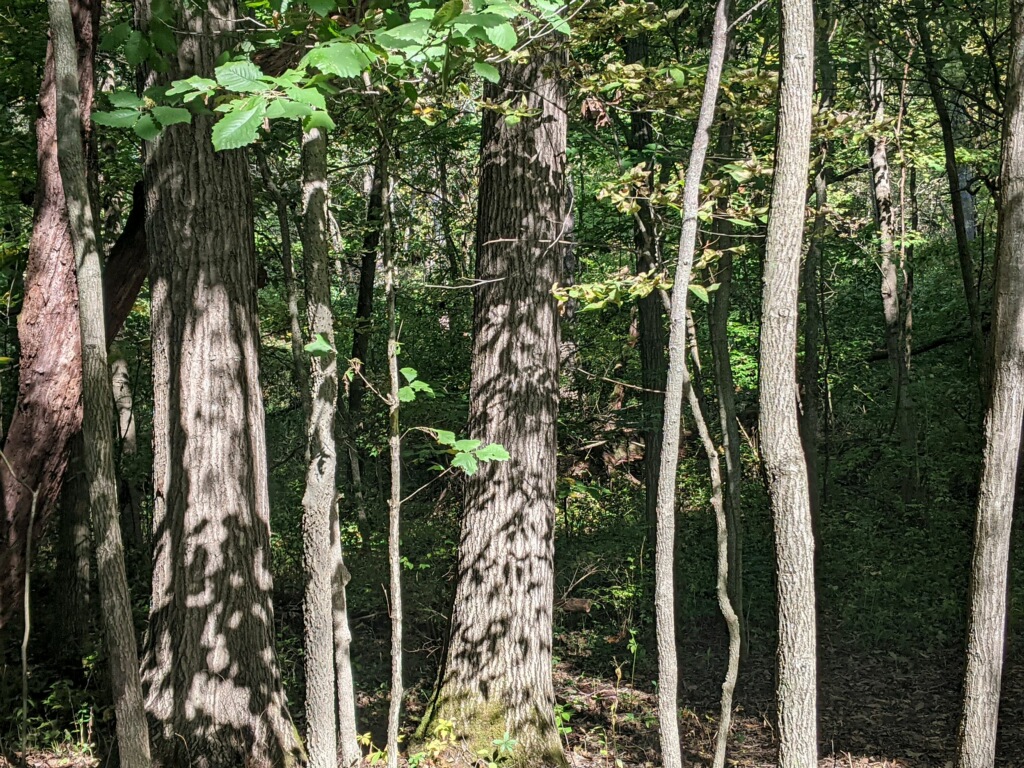
Go to any wooded area and you will see not a tessellation of nearly overlapping circles but a tangled, irregular canopy of mature trees, more densely planted and with their crowns intermingled. Below ground, their root systems will be likewise intermingled tightly. Trees can and do exchange nutrients with each other below ground, and interwoven roots help all plants resist stressors like high winds and drought.
In his recently released book, The Nature of Oaks, Doug Tallamy points out that the habit of too-thin planting of large trees like oaks is cheating our local environment of its ecological potential. He advises the planting of oaks, which many people imagine they do not have room for, in tight groves with spacings as close as 10’ centers. Trees can be planted even closer than this, with a trio planted on 3-foot centers, maturing into a cluster that will appear to the eye as one individual. An oak tree is the single most ecologically impactful tree in our North American ecosystems, but a grove of oaks magnifies this effect immensely.
October 2021 Newsletter
